The Journey
The crossing in the
ship holds
Once on board, the captive people were chained up in the holds of the ships in inhuman conditions. These spaces were often modified to increase capacity and make the journey more profitable, with little change to the ship’s overall appearance. When the trade became illegal, the conditions of the crossing worsened even further. The voyage lasted between two and three months, and it is estimated that around 15% of the captives died during the transatlantic journey.
When the ships reached the American ports, the traffickers sold the captured people to private individuals, with local merchants acting as intermediaries. From that moment on, they were enslaved and forced to work in domestic service or — in the case of Cuba and Puerto Rico — mainly on coffee and sugar plantations. After 1821, when the trade was outlawed, ships had to disembark the African captives in secret, along the beaches and mangroves of Cuba and Puerto Rico.
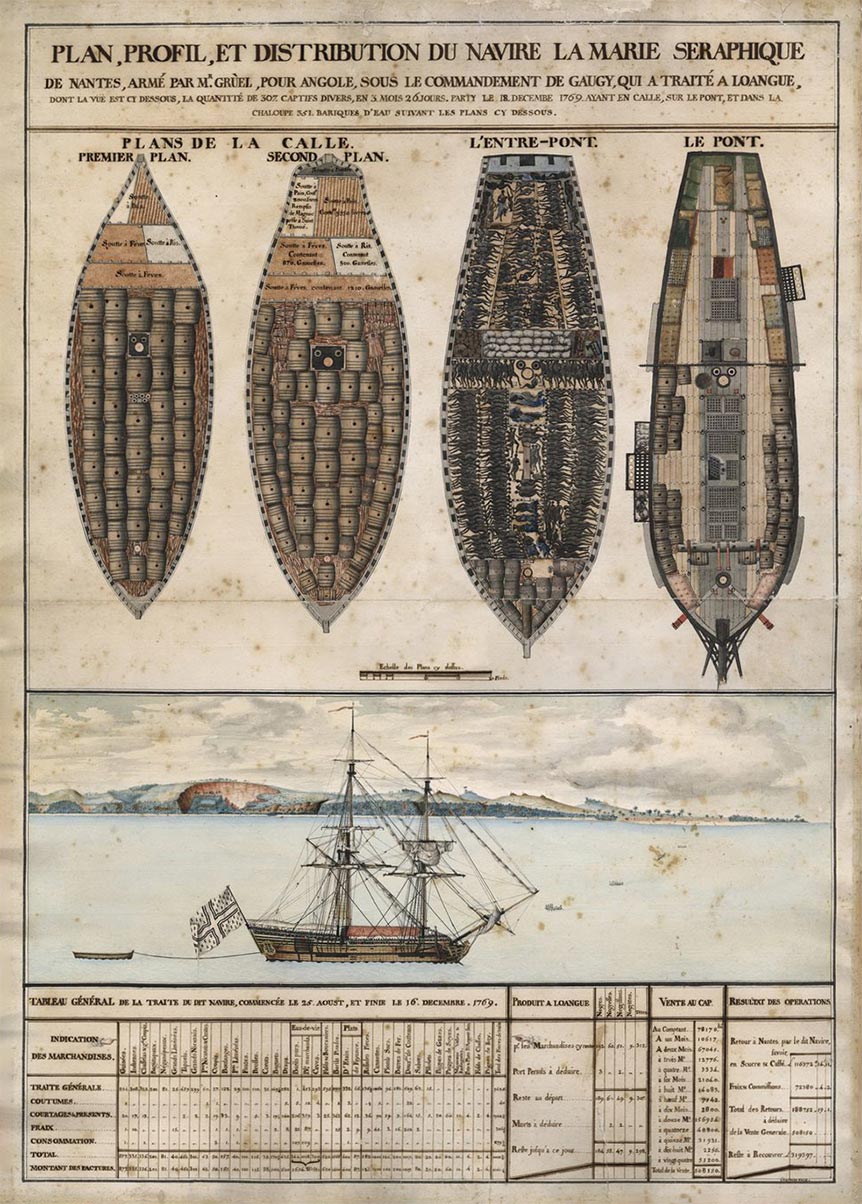
La Marie Séraphique de Nantes, armé par Mr Gruel, pour Angole, sous le commandement de Gaugy, qui a traité à Loangue, dont la vue est cy-dessous la quantité de 307 captifs (…)
(The ship The Séraphique Marie of Nantes, outfitted by Mr Gruel, for Angola, under the command of Gaugy, who dealt in Loango, whose sight is below the quantity of 307 captives (…)).
Reproduction of the watercolor made around 1770 by René Lhermitte and preserved in the Château des Ducs de Brittany – Musée d’Histoire de Nantes (France).
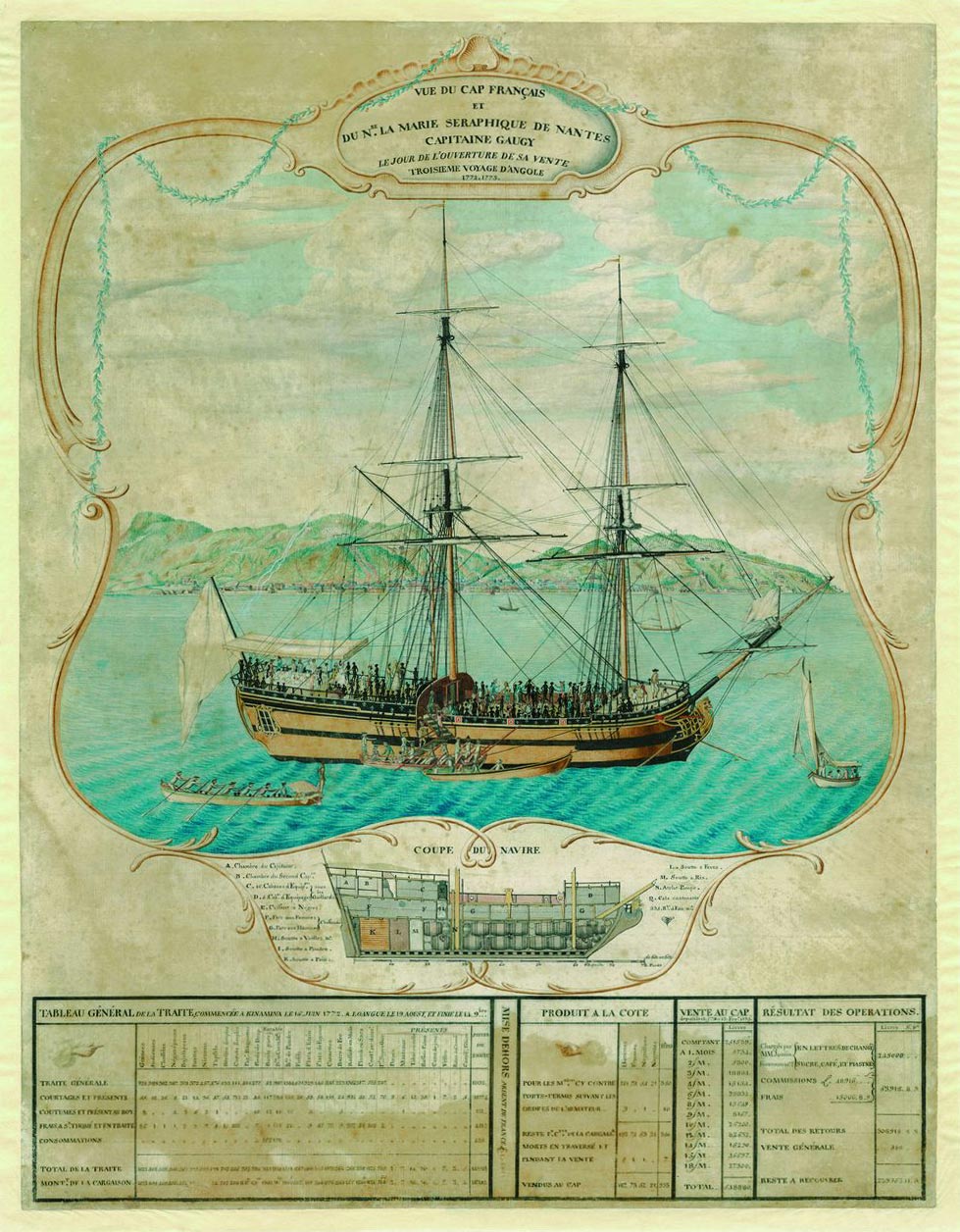
Vue du Cap Français et du Nvr La Marie Séraphique de Nantes, capitaine Gaugy, le jour de l’ouverture de sa vente, troisième voyage d’Angole, 1772-1773.
(View of Cap Français and the ship La Marie Séraphique de Nantes, by captain Gaugy, on the day of the opening of her sale, third voyage to Angola, 1772-1773).
This watercolor illustrates the third voyage of La Marie-Séraphique, organized by the shipowner Gruel, from February 18, 1772 to April 3, 1773. The document describes the sale of captives on board. It also details the removal of the captives and the result of the operation, as well as a cross-section of the ship, showing the specific characteristics of a slave ship.
Reproduction of the anonymous watercolor made around 1773 and preserved in the Château des Ducs de Bretagne – Musée d’Histoire de Nantes (France).
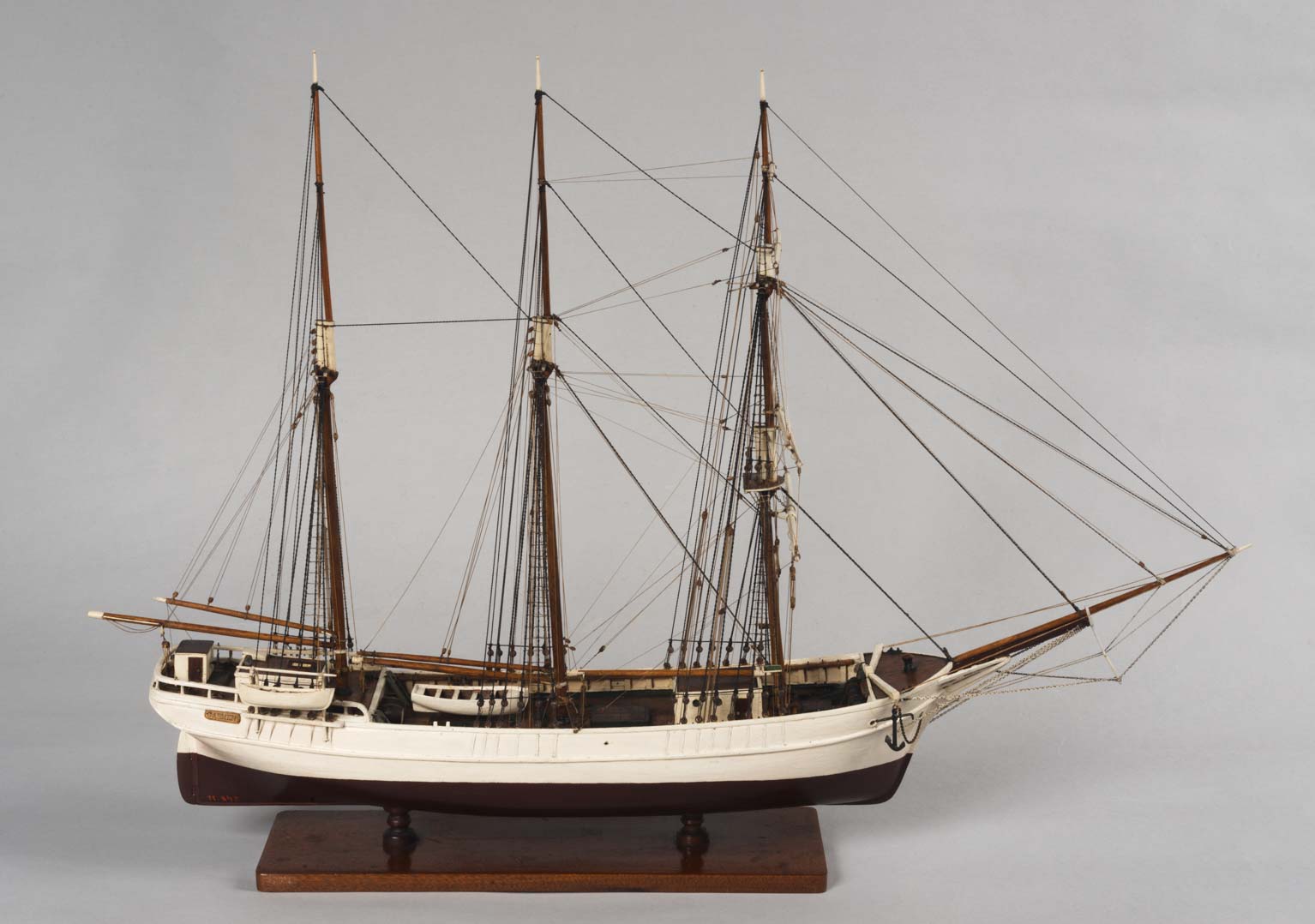
Ship model of the schooner brig Carmen
This type of sailboat, small and light, was used by the Catalans for the trafficking of enslaved people.
Ship model made by Mariano M. Sastre Carreras (1915-1963).
MMB
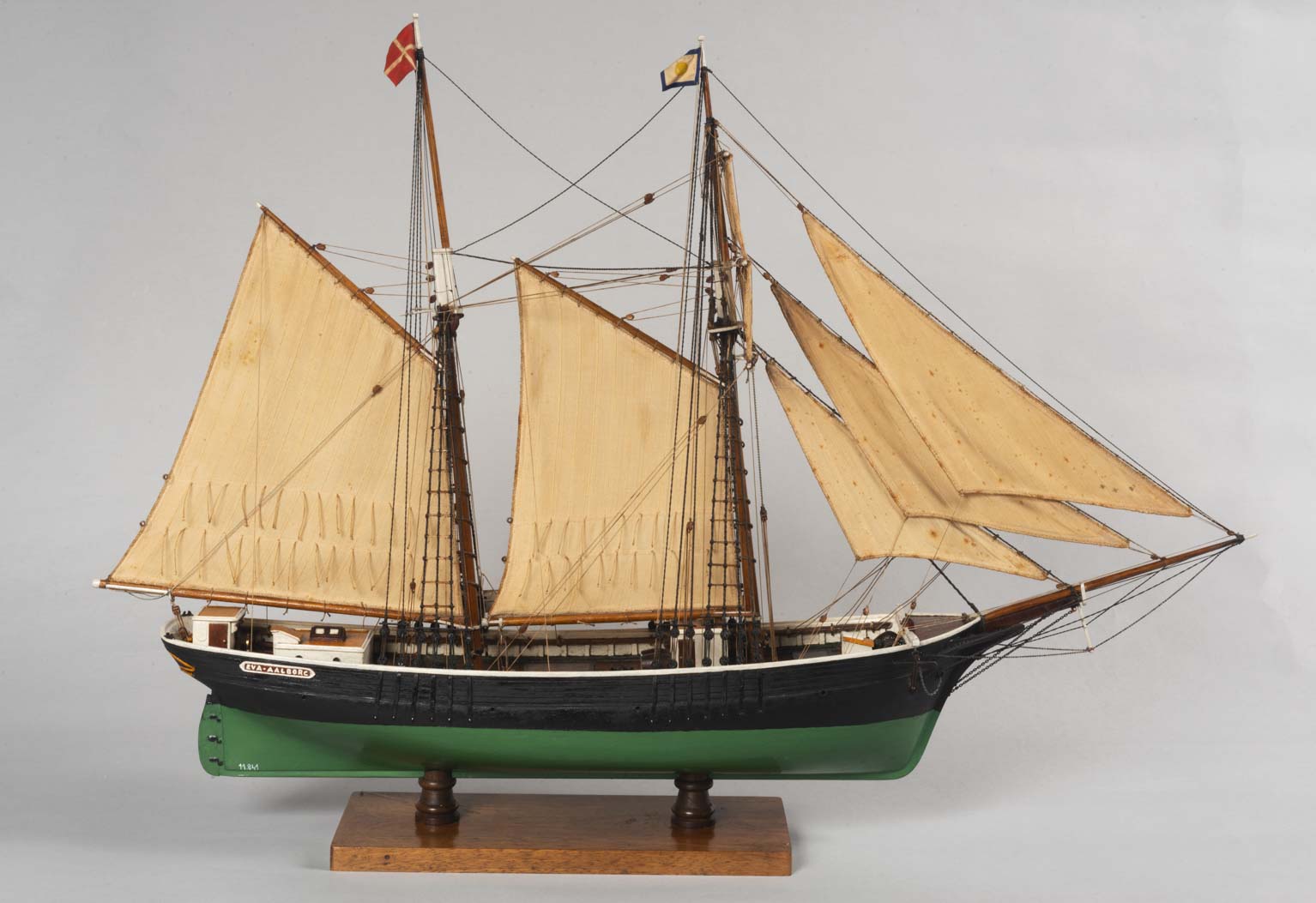
Ship model of the schooner with a fore-top sail Eva
This type of sailboat, small and light, was used by the Catalans for the trafficking of enslaved people.
Ship model made by Mariano M. Sastre Carreras (1915-1963).
MMB
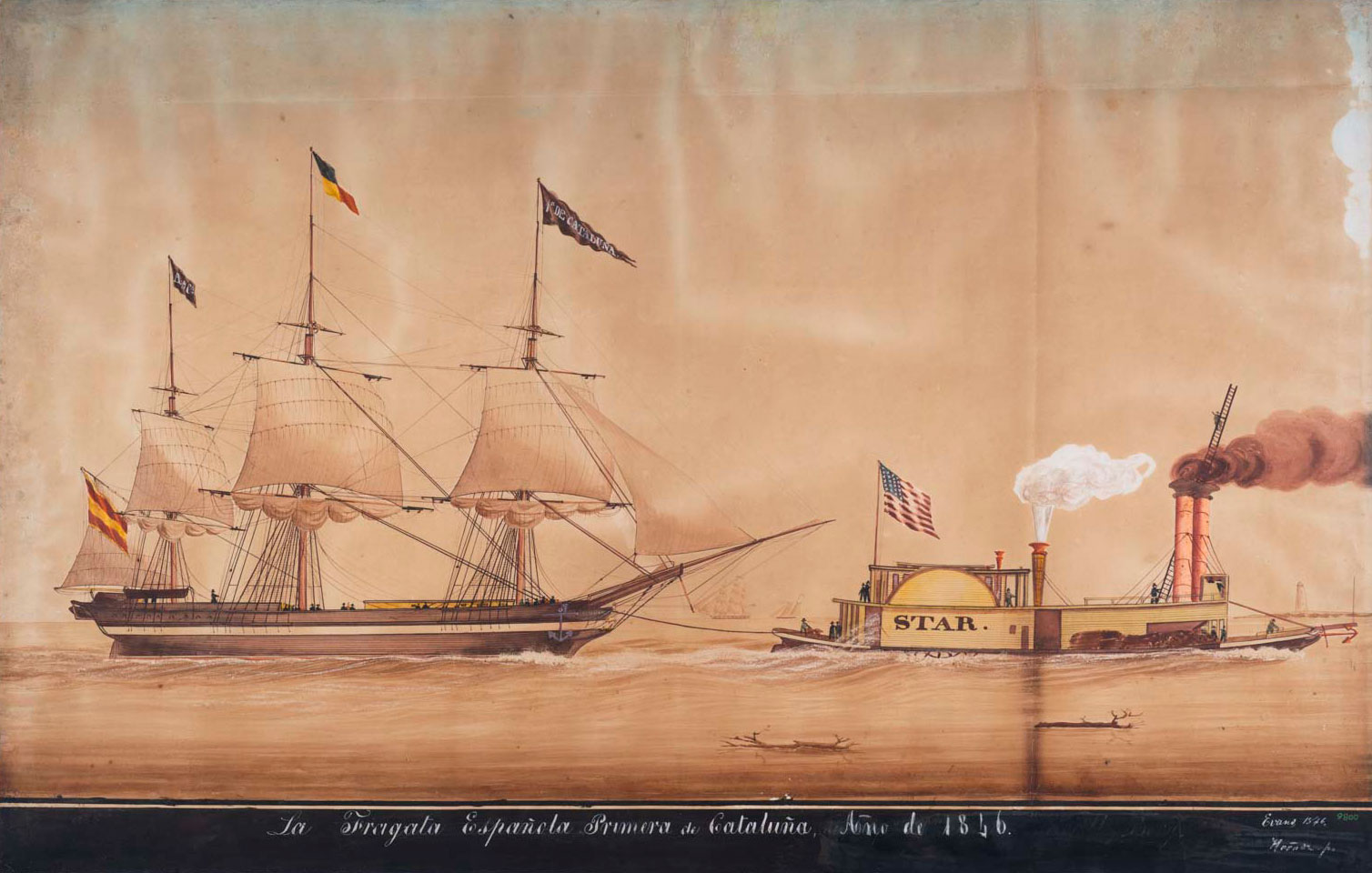
La fragata española Primera de Cataluña. Año de 1846.
This frigate was built in San Francisco (USA) and registered in Havana in 1846. It was owned by Josep Torrents Serramalera (Moià, 1796 – Barcelona, 1854), owner of a fleet of sailing ships, some of which, like this one, were used in the slave trade.
Tempera on paper by James Guy Evans (1846)
MMB
EX-VOTOS BEARING WITNESS TO THE TRAFFICKING OF ENSLAVED PEOPLE
The Spanish Crown banned the trade in 1817 through a bilateral treaty with the United Kingdom that made it completely illegal from 1821 onwards.
Despite this, the activity continued because slave labour was not prohibited in the colonies. To combat illegal trafficking, a joint Spanish-British court was established in Freetown, now the capital of Sierra Leone, to try ships captured while engaging in this trade. The other joint Spanish-British court was established in Havana. The British navy became a veritable maritime police force against ships that violated the ban. Thanks to the documents from these two courts, we now know some of the stories.
The Maritime Museum of Barcelona holds a wide variety of maritime ex-votos, including some that recount how certain ships managed to escape pursuit by the British Navy while trafficking enslaved people.
The barca de mitjana Uracán, pursued by the English steamer Graules
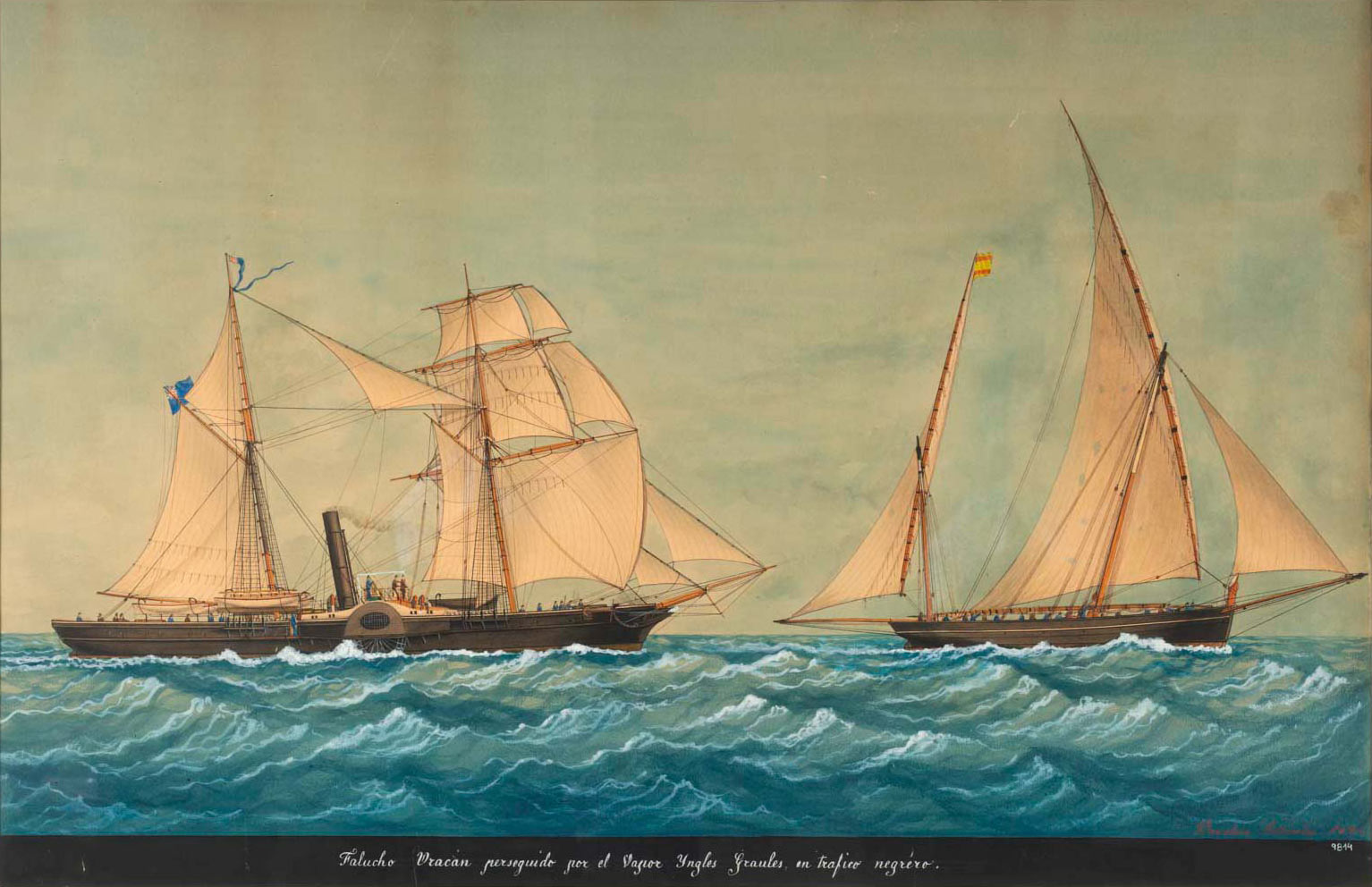
Falucho Uracan perseguido por el vapor inglés Graules en tráfico negrero .
Tempera on paper by José Pineda Guerra (1884)
MMB
On November 9, 1841, the barca de mitjana Uracán was launched from the shipyard of master shipwright Josep Vieta in Blanes. It measured 90 feet in length, 23 in beam, and had a tonnage of 110. Its first captain was Gaspar Roig Llenas, born in Vilassar de Mar and based in Barcelona. The owners were indianos Jaime Batey and José Rabasa, both established in the Cuban port of Matanzas.
At the end of 1842, the Uracán embarked 256 people purchased at a factory in Gallinas, in present- day Sierra Leone. Three months later, it disembarked 186 people in Matabajo, near the Cuban town of Guantánamo. The rest likely perished during the crossing. Despite complaints from British representatives on the island, Spanish military authorities turned a blind eye—probably in exchange for a bribe. Thus, the Uracán was able to deliver its human cargo to the buyers.
But the British already had their eye on it. Since 1821, human trafficking had been illegal, and British ships had become a true anti-slavery maritime police force. The Uracán was one of their primary targets.
On January 12, 1845, while attempting to enter Gallinas once again, the Uracán encountered the British steamer Growler, tasked with pursuing slave ships along the African coast. Lieutenant Lodwick, who commanded the vessel, launched a boat to inspect the barca de mitjana. Suddenly, when the boat was just 30 yards away, the Uracán opened fire. However, thanks to a gust of wind that shifted its position, the bullets passed over the British boat. Lieutenant Lodwick responded with 180 shots. During the exchange, two British men were killed, and Lodwick along with two others were seriously wounded. The Uracán’s volleys left the British boat with six oars destroyed and so few able-bodied men that they had no choice but to retreat.
From that moment on, the Uracán became the most sought-after prize for British naval officers. We know of at least six pursuits: once by the ship Waterwitch, commanded by Captain Matson, another by a vessel dependent on that same ship, twice by the Iris, when this ship was commanded by Captain Tucker, once by the steamship Kite, and again by the steamship Growler. Of all these pursuits, the Uracán managed to escape.
Finally, on 24 February 1845, when the Uracán was captained by Jaume Guardiola, from San Félix de Guíxols, and while it was loading people purchased at a factory in Whydah (now Ouidah, in Benin), the British steamship Hydra stopped and boarded it. There were 70 slaves on board. We know the names of some of these people: Loando, a 24-year-old man; Yangee, a 21-year-old woman; Samoo, a 9-year-old boy; Sambah, a 10-year-old girl; Mosungoo, a 28-year-old wife; Jaree, a 19-year-old young man.
The court in Sierra Leone ordered the ship to be sold at public auction and the kidnapped persons to be released. They were unable to convict the crew because, surprisingly, they had fled on a French ship.
The capture of the slaving corvette Conchitaby the English cruiser steamship Firefly
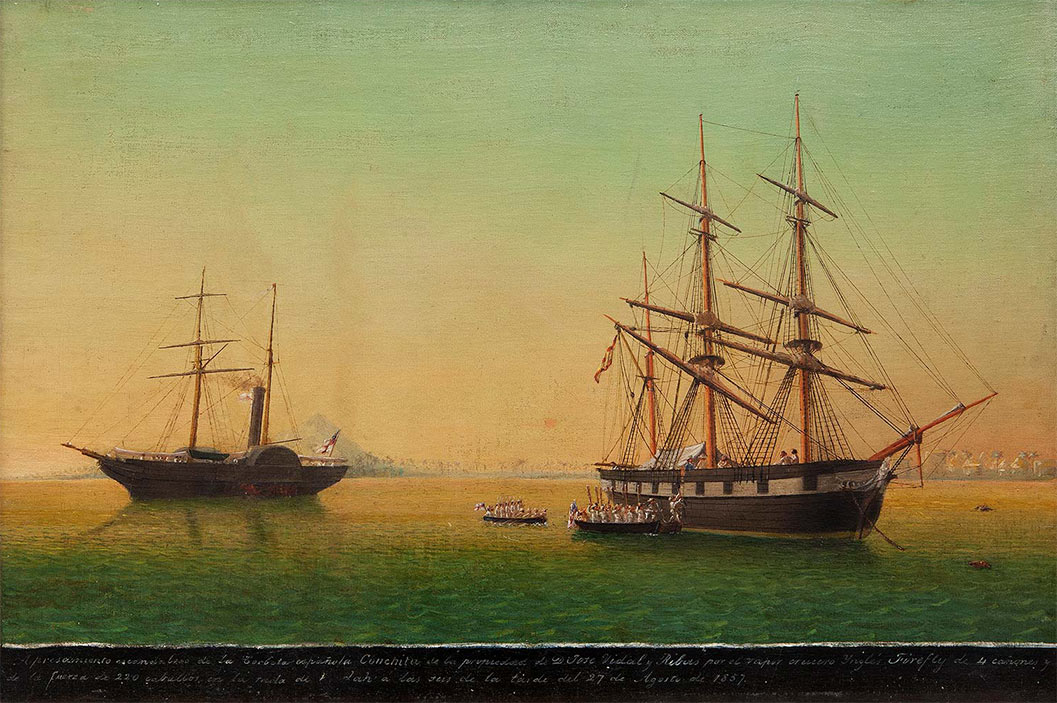
Apresamiento escandaloso de la corbeta española Conchita de la propiedad de D. José Vidal y Ribas por el vapor crucero inglés Firefly de 4 cañones y de la fuerza de 220 caballos en la roda de Wydah a las 6 de la tarde del 27 de agosto de 1857
(Scandalous seizure of the Spanish corvette Conchita, owned by José Vidal y Ribas, by the English cruiser Firefly, armed with four cannons and powered by a 220 horsepower engine, at Wydah at 6 p.m. on 27 August 1857)
Anonymous oil on canvas (1857)
MMB
The legend on the ex-voto reveals the following event:
Apresamiento escandaloso de la corbeta española Conchita, propiedad de D. José Vidal y Ribas, por el vapor crucero inglés Firefly, de 4 cañones, y de la fuerza de 220 caballos en la roda de Wydah a las 6 de la tarde del 27 de agosto de 1857.
(Scandalous seizure of the Spanish corvette Conchita, owned by Mr. José Vidal y Ribas, by the English patrol steamer Firefly, armed with 4 cannons and powered by 220 horsepower, off the coast of Wydah at 6 p.m. on August 27, 1857.)
The corvette Conchita, together with the schooners Mariana and Fernando Poo, was one of three ships owned by the company Vidal, Mustich & Co., founded in 1846 by Josep Vidal i Ribas (who would become one of Barcelona’s most important merchants and vice-president of the Board of Trade), Domènec Mustich (owner of factories in Popo and Aghwey, in present-day Benin) Torrens i Miralda (businessman who promoted gas lighting in Barcelona) and Esteve Gatell Padrinas (also involved in human trafficking).
The Conchita left Barcelona on 23 December 1856, captained by Joaquim Roig and loaded with spirits and empty barrels. The first stop was in Gibraltar, where it took on English goods. It then sailed to Accra (Ghana). From there, following orders from Josep Vidal y Ribas’ representative, it continued on to Aghwey (present-day Benin), where it delivered part of the cargo to Domènec Mustich. From there, it continued on to Bahia, Brazil. The British already suspected that slaves were being transported on this voyage. In Bahia, the Conchita took on tobacco and spirits and sailed to Whydah (now Ouidah, Benin), where the cargo was exchanged for palm oil. On 27 August, the ship was captured by the British navy in Aghwey.
According to British reports, the crew stated that ‘the ship was to take on a cargo of slaves as soon as it had unloaded its holds, and was entirely dependent on not being searched again’. British officers suspected that the ship was expecting to load 400 people to sell them in the American colonies.
The Sierra Leone court condemned the ship and ordered the crew to be sent to the Canary Islands to be tried by the Spanish authorities—but that did not happen: upon arrival on the islands, they were released.
The case received prominent coverage in the Catalan press, especially in the Diario de Barcelona, and in the Spanish press, with a fierce defence of the ship and the activities of Catalan ship owners and a request for a review of the terms of the treaty with the United Kingdom on the prohibition of human trafficking.
The company’s other two ships, Fernando Poo and Mariana, were also captured by the British. At the time of their capture, they were not carrying any kidnapped persons on board, but they were carrying material that suggested they were going to look for slaves.
The felucca Bayhanopursued by a British Navy vessel
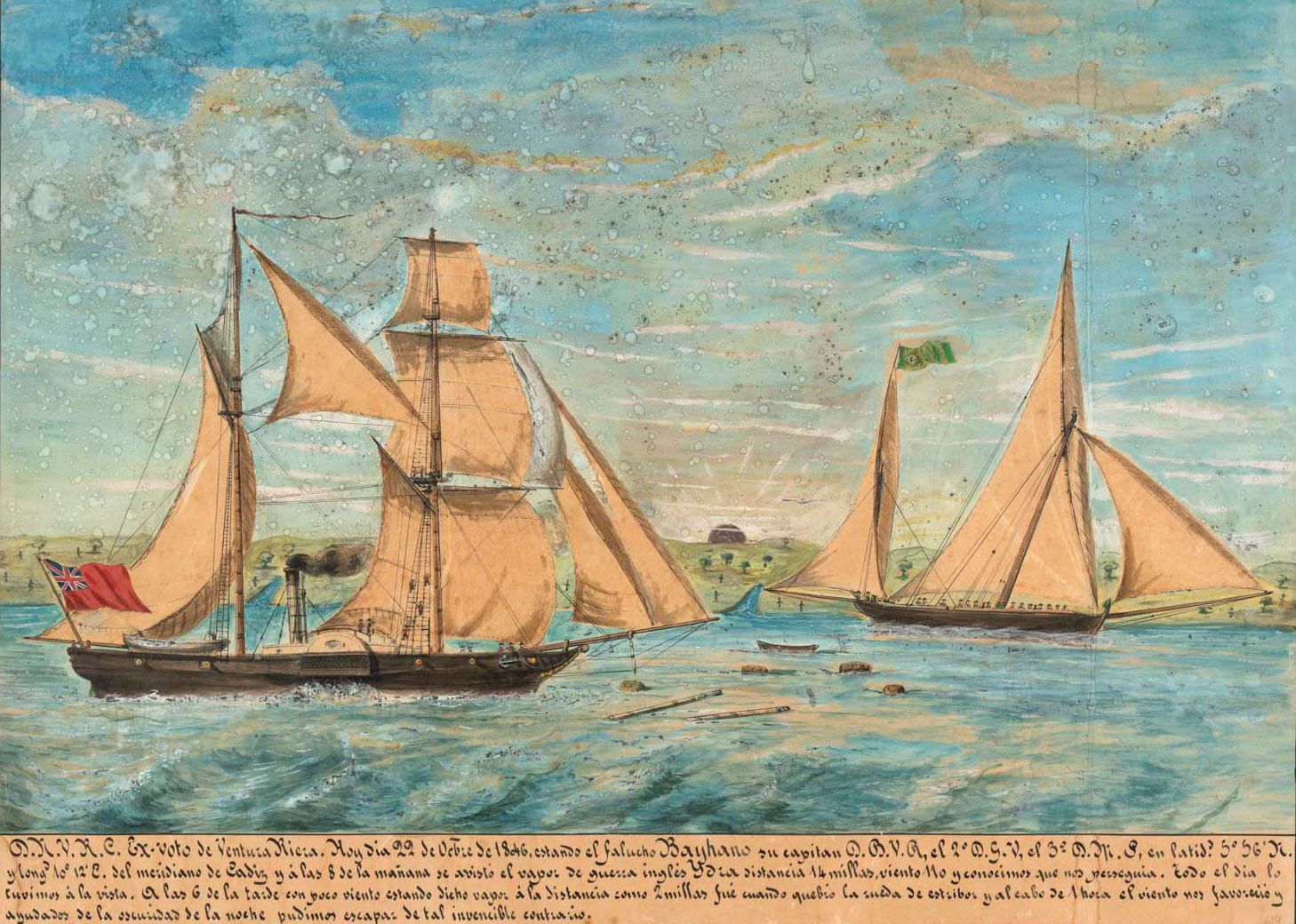
DNVRC Bayhano Ex-voto de Ventura Riera.
(DNVRC Bayhano Ex-voto by Ventura Riera)
Anonymous tempera on paper (1846)
MMB
Another ex-voto that recounts the British navy’s pursuit of a Catalan ship trafficking enslaved people is that of Ventura Riera, whose legend recounts the episode well:
DNVRC Bayhano Ex-voto de Ventura Riera. Hoy día 22 de octubre de 1846, estando el falucho Bayhanosu capitan DBVR el 2º DGV, el 3ª DMS en la latitud 5º 56’ N y la longitud 10º 12’ E del meridiano de Cádiz y a las 8 de la mañana se avistó un vapor de guerra inglés y día de distancia 14 millas, viento NO y conocimos que nos perseguia. Todo el día lo tuvimos a la vista, a las 6 de la tarde con poco viento estando dicho vapor a la distancia como dos millas fue cuando quebró la rueda de estribor y al cabo de 1 hora el viento nos favoreció y ayudados de la oscuridad pudimos escapar de tal inven-cible contrario.
(DNVRC Bayhano Ex-voto by Ventura Riera. On this day, October 22, 1846, while the felucca Bayhano was under the command of captain DBVR, the second officer DGV, and the third officer DMS, at latitude 5º 56› N and longitude 10º 12’ E from the meridian of Cádiz, at 8 in the morning a British war steamer was sighted at a distance of 14 miles, wind from the NW, and we realized it was pursuing us. We had it in sight all day; at 6 in the evening, with little wind and the steamer about two miles away, the starboard wheel broke, and after an hour the wind favoured us and, aided by the darkness, we were able to escape from such an invincible opponent.)
As in previous cases, this ex-voto is an offering from a crew member, Ventura Riera —possibly the captain, given the partial match of the initials appearing in the inscription— in gratitude for divine intercession after escaping the pursuit of the British Navy steamer Hydra, in the waters of the Gulf of Guinea. The ex-voto comes from the Hermitage of la Cisa, in Vilassar de Mar
Although we do not have as much information as in the case of the other two examples presented in the exhibition, we can still provide some data about the ship and the episode depicted. The Bayhano was a vessel built by the shipwright Francesc Segarra of Vilassar de Mar (Barcelona) in 1846. This chronological coincidence between the construction date of the ship and the episode represented in the ex-voto suggests that the vessel was involved in the trafficking of people from the outset.
The accuracy of the narrative in the ex-voto inscription is quite precise and, moreover, aligns with the account recorded in the logbook of the British steamer Hydra, which led the pursuit in compliance with the agreements signed during the first third of the 19th century between Spain and Great Britain for the suppression of the (now illegal) slave trade. British captain H.B. Young recorded the event as having occurred on October 20, 1846—not the 22nd—and corrected the geographical coordinates, placing the episode squarely in the Gulf of Guinea, off the coast of what is now Nigeria.