And What Did People Think About All This?
Catalan Society and Slavery: Pro-Slavery and Abolitionist Voices
On one side stood the economic elites, represented by bodies like the Junta de Comerç (Barcelona Board of Trade) and the Círculo Hispano-Ultramarino (Hispanic Ultramarine Circle) of Barcelona, who actively defended the institution of slavery.
In 1841, the Junta de Comerç (Board of Trade) of Barcelona published a manifesto opposing the British abolitionist push in Cuba. It also expressed its rejection of the idea that the Spanish Congress of Deputies should even be allowed to debate whether slavery ought to be abolished in the Spanish Antilles.
“…. temor de que nuestro Congreso se empeñe inconsideradamente en la cuestión de esclavitud y en realidad si esto aconteciese la sola discusión sería una señal de terrible alarma para nuestras posesiones ultramarinas, porque aquellos habitantes recelosos de la inexperiencia y ardimiento declamatorio que acompaña generalmente semejantes debates, verían en ellos el origen de una lucha estemporánea [sic] pero que pasmaría el espíritu de empresa y la confianza se extinguiría en aquellos países, hasta el punto de provocar la emigración de los blancos con sus capitales”
(“…fear that our Congress might rashly take up the issue of slavery, for should this occur, even the mere discussion of it would be a terrible alarm bell for our overseas possessions. The inhabitants there, wary of the inexperience and declamatory fervour that typically accompany such debates, would see in them the beginnings of an untimely conflict — one that would paralyse the spirit of enterprise and extinguish confidence in those territories, to the point of provoking the emigration of white people along with their capital.”)
In that manifesto they also, and above all, demonstrated their total opposition to supporting British abolitionist claims:
“Nosotros invocaremos con toda la energía que merece la gravedad de este negocio el apoyo de la Junta de Comercio para que represente al Supremo Gobierno a fin de contener estas invasiones extranjeras con grave peligro de la soberanía de la metrópoli. Este es el pretesto [sic] con que la poderosa Albión quiere infiltrarse, por decirlo así, en todas las 35 cuestiones futuras que puedan ocurrir sobre la libertad de los esclavos y si no se corta de raíz semejante abuso,plantamos desde ahora un semillero de discordias y de compromisos en nuestras colonias.
“We shall invoke, with all the energy that the gravity of this business deserves, the support of the Board of Trade (Junta de Comercio) so that it may represent before the Supreme Government the need to restrain these foreign invasions, which pose a grave danger to the sovereignty of the Metropolis. This is the pretext under which powerful Albion seeks to infiltrate, so to speak, all future questions that may arise regarding the freedom of slaves; and if such an abuse is not nipped in the bud, we are sowing, as of now, the seeds of discord and compromise within our colonies.”
In 1871, the Barcelona branch of the Círculo Hispano-Ultramarino (Hispanic Ultramarine Circle) was established — a pro-slavery lobbying group, with the indianos Joan Güell i Ferrer and Antonio López serving as president and vice-president, respectively. A year later, the Liga Nacional de Barcelona was founded, opposing the abolition of slavery in Puerto Rico. In December 1872 and January 1873, the Barcelona Círculo published two manifestos: one signed by businessmen and politicians, and another signed exclusively by women, with hundreds of signatures from both private individuals and companies..
No queremos la esclavitud. ¿Qué hemos de quererla si somos mujeres y católicas? Pero queremos menos aún que se suma en la barbarie a los infelices a quienes se pretende favorecer, haciendo de la hermosa Cuba, de la bella Puerto Rico, dos tribus semejantes a la desdichada Santo Domingo(…) Póngase un arma en manos de un niño y se herirá con ella. Niño es el que ha vivido siempre bajo tutela y arma mortífera la libertad para quien no sabe hacer de tan precioso don el uso conveniente(…) Mucho se habla y mucho se desbarra […] al tratar de esta delicada cuestión, porque se presta tanto a pomposas y altisonantes declamaciones […]. Pero la verdad es que los que más declaman contra la mal llamada esclavitud de las Antillas, filántropos de apariencia y católicos dedoublé, tratan con más despótico desprecio a sus criados que los habitantes de Cuba y Puerto Rico a sus llamados esclavos (…) Además, Excmo. Señor [seguían dirigiéndose a Ruiz Zorrilla, presidente del Consejo de Ministros] que uso conveniente se quiere que hagan [los esclavos] de su libertad sin preparación alguna, unos seres que por sus naturales instintos, por su condición y por otras razones de todos conocidas, no saben vivir sino guiados por el suave yugo de los consejos y del amor de sus amos, con los que se hallan identificados”
(We do not want slavery. Why would we want it, if we are women and Catholics? But we want even less that those unfortunate people whom others claim to be helping should be plunged into barbarity — turning beautiful Cuba and lovely Puerto Rico into tribes resembling unfortunate Santo Domingo. (…) Hand a weapon to a child, and he will hurt himself with it. A child is someone who has always lived under tutelage, and freedom is a deadly weapon for those who do not know how to use such a precious gift wisely. (…) Much is said — and much nonsense too — […] when speaking of this delicate issue, because it lends itself so easily to pompous and high-sounding declamations […]. But the truth is that those who most loudly denounce the so-called slavery of the Antilles — these so-called philanthropists and so-called Catholics — treat their own servants with more despotic contempt than the inhabitants of Cuba and Puerto Rico treat their so-called slaves. (…) Furthermore, Your Excellency [they continue addressing Prime Minister Ruiz Zorrilla], what right use of freedom can possibly be expected from people who have had no preparation whatsoever — beings who, by their natural instincts, by their condition, and for other well-known reasons, cannot live except under the gentle yoke of the advice and love of their masters, with whom they are united?)
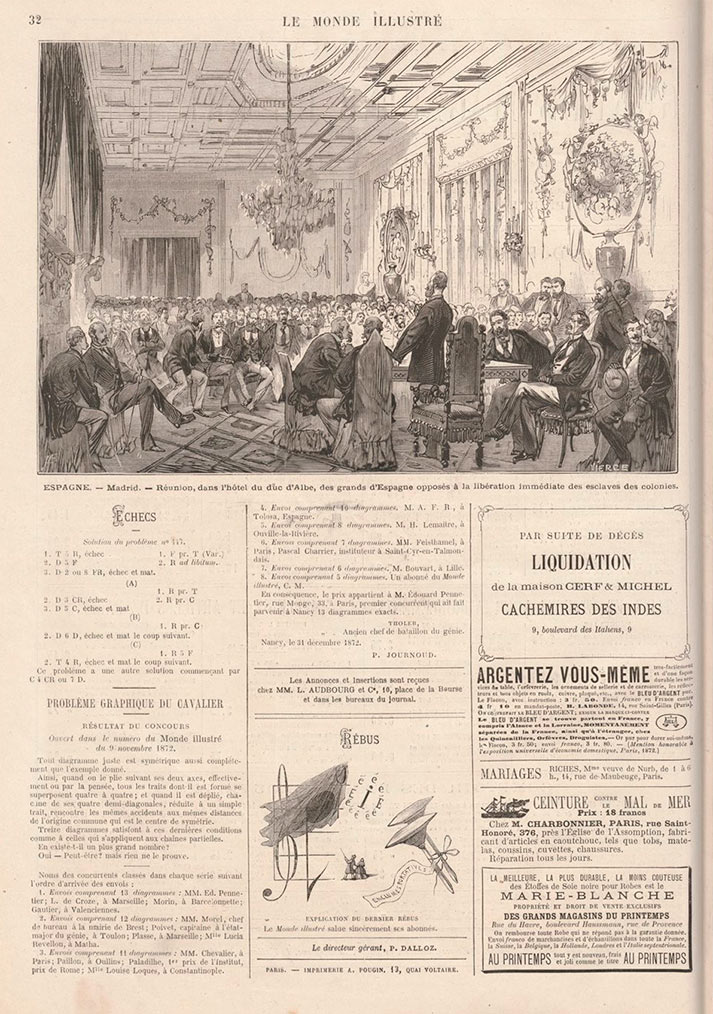
Espagne. Madrid. Réunion dans l’hôtel du duc d’Albe, des grands d’espagne opposés à la libération immédiate des esclaves des colonies.
(Meeting at the Hotel Duque de Alba in Madrid of Spanish nobles opposed to the liberation of enslaved people in the colonies)
Illustration published in Le Monde Illustré (11 January 1873).
Gallica, Bibliothèque National de France.
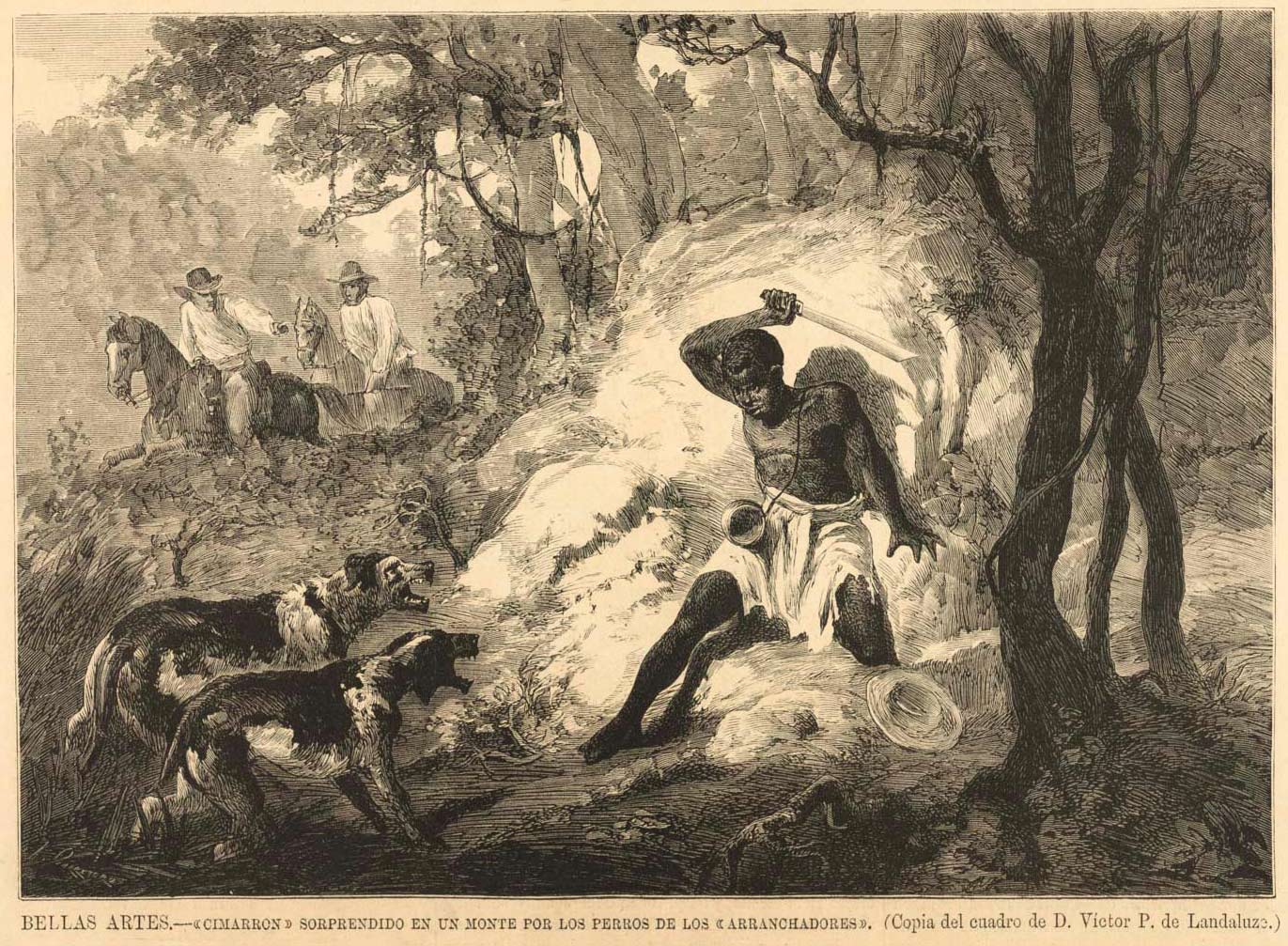
Cimarrón sorprendido en un monte por los perros de los arranchadores.
(Cimarrón surprised in the mountains by the dogs of the ranchers)
Copy of the painting by Víctor Patricio de Landaluze.
Illustration published in the magazine La Ilustración Española y Americana, September 1874.
MMB
In 1868, the Ten Years’ War broke out — the first war for Cuba’s independence. It was a conflict led by local elites against Spanish colonial rule, and the enslaved population joined the uprising. In defence of the colonial status quo, 3,500 young Catalan volunteers enlisted to fight alongside the regular army against the separatist abolitionists.
On the other hand, the more progressive sectors of society promoted the abolition of slavery.
Spanish Abolitionism began during the debates over the drafting of the 1812 Constitution, at the Cortes of Cádiz. However, that first democratic constitution did not include the abolition of slavery. Throughout much of the 19th century, silence on the issue prevailed — partly due to the Spanish crown’s vested interests in Cuba’s sugar plantations.
The Revolution of 1868 revitalised the abolitionist movement, even more so following the end of slavery in the United States after the Civil War.
In 1864, the Sociedad Abolicionista Española (Spanish Abolitionist Society) was founded. It included leading economists and politicians such as Laureà Figuerola, Joaquim Maria Sanromà, and Francesc Pi i Margall, as well as other liberal figures like Salustiano de Olózaga, Segismundo Moret, and Rafael María Labra. The society also had a women’s section, the Sociedad Abolicionista de Señoras, chaired by the activist Carolina Coronado.
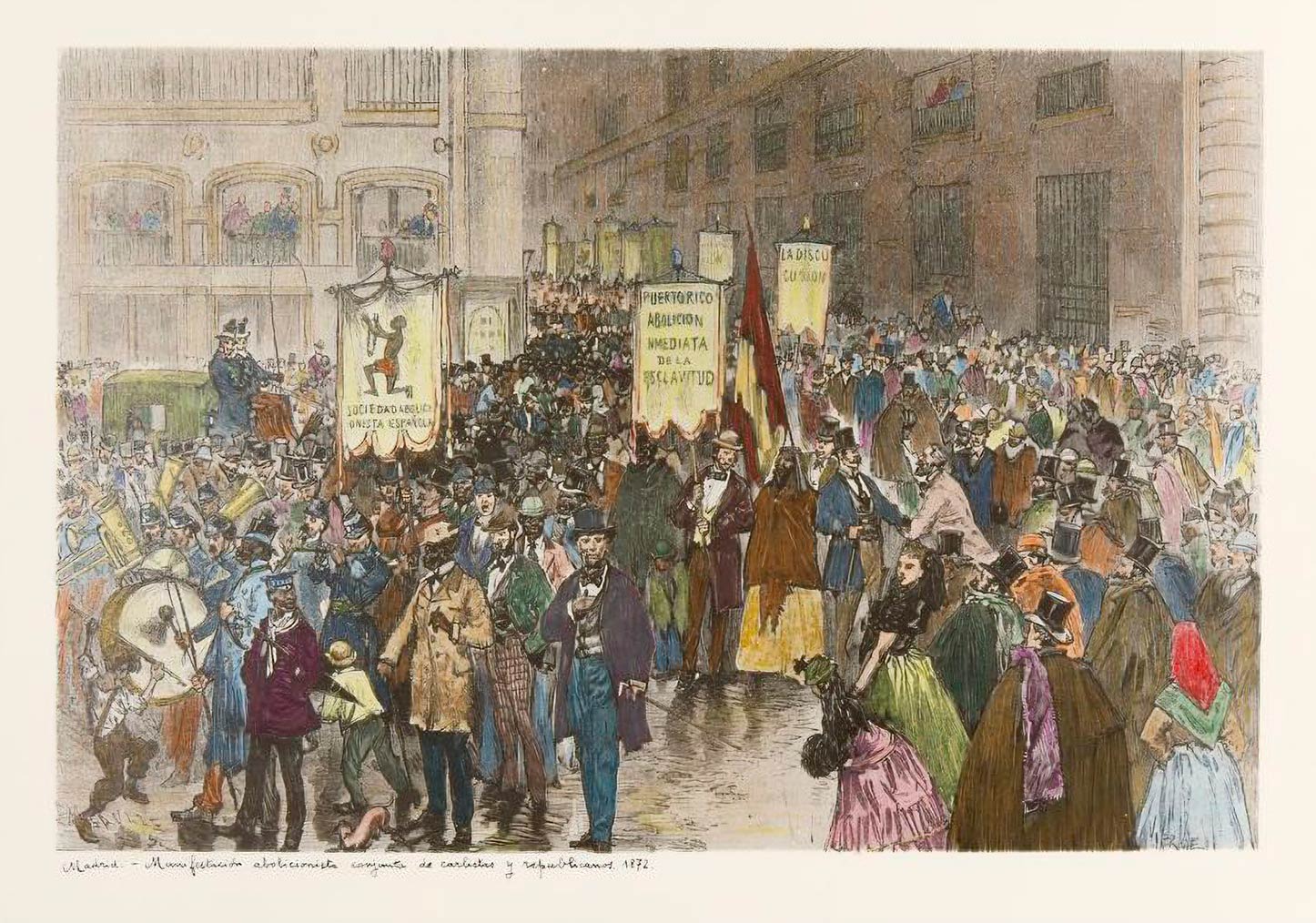
Among the Catalan abolitionists were figures such as the musician and feminist Clotilde Cerdà, the publisher Antonio Bergnes de las Casas, as well as several prominent politicians and economists. In 1872, Barcelona hosted its first major abolitionist demonstration.
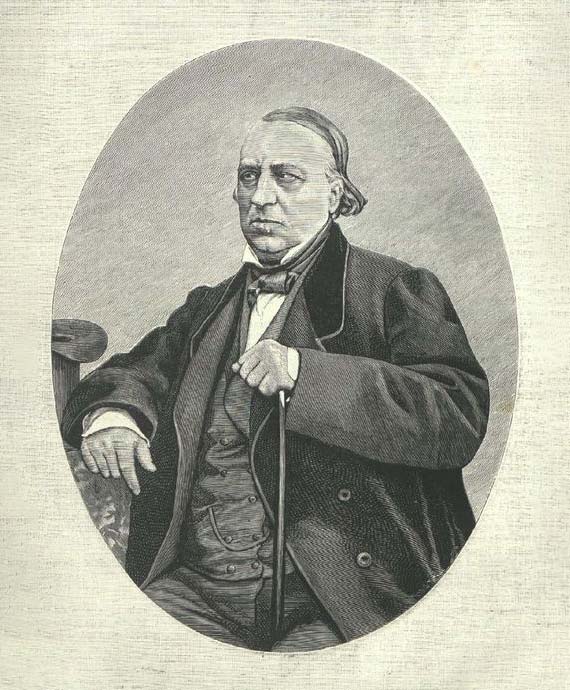
Don Antonio Bergnes de las Casas, [deceased] on 17 November 1879.
Portrait published in El mundo ilustrado.
Biblioteca Nacional de España
The Publisher Antoni Bergnes de las Casas
Around 1840, an abolitionist circle began to form in Barcelona around Antoni Bergnes de las Casas (1801–1879). A Hellenist, publisher, and Rector of the University of Barcelona from 1868 to 1875 — during the Sexenni Revolucionari (Six-Year Democratic Period) — Bergnes translated and published several British abolitionist works in Spanish. He also edited the magazine El Museo de las Familias, which featured abolitionist articles.
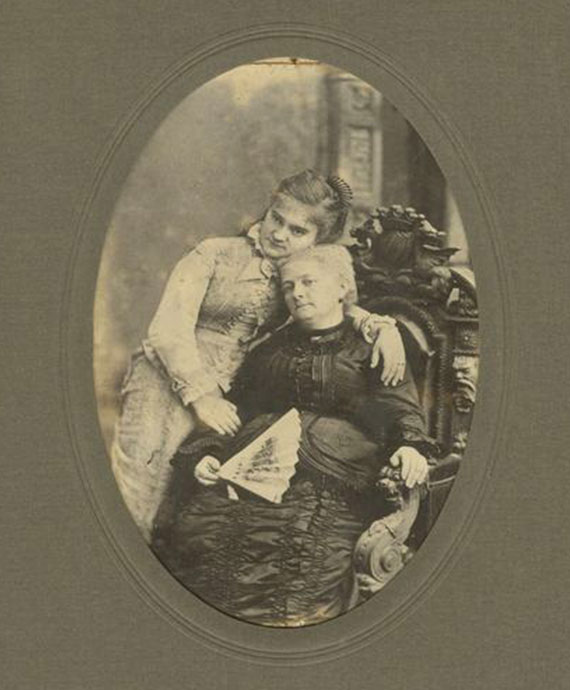
Clotilde Cerdà and her mother Clotilde Bosch
Biblioteca de Catalunya
Clotilde Cerdà
At the first abolitionist demonstration held in Barcelona, on 21 December 1872, Clotilde Cerdà, known artistically as Esmeralda Cervantes, may have been present. In addition to being a renowned harpist, Cerdà was an activist for feminism and a vocal opponent of both the death penalty and slavery. During a trip to Cuba in 1876, she defended the abolition of slavery.
Clotilde was the daughter of the painter Clotilde Bosch and Ildefons Cerdà, the engineer who designed Barcelona’s Eixample district. She was also the granddaughter of Josep Bosch i Mustich, an indiano who made his fortune in Cuba and later directed the Barcelona–Mataró railway.
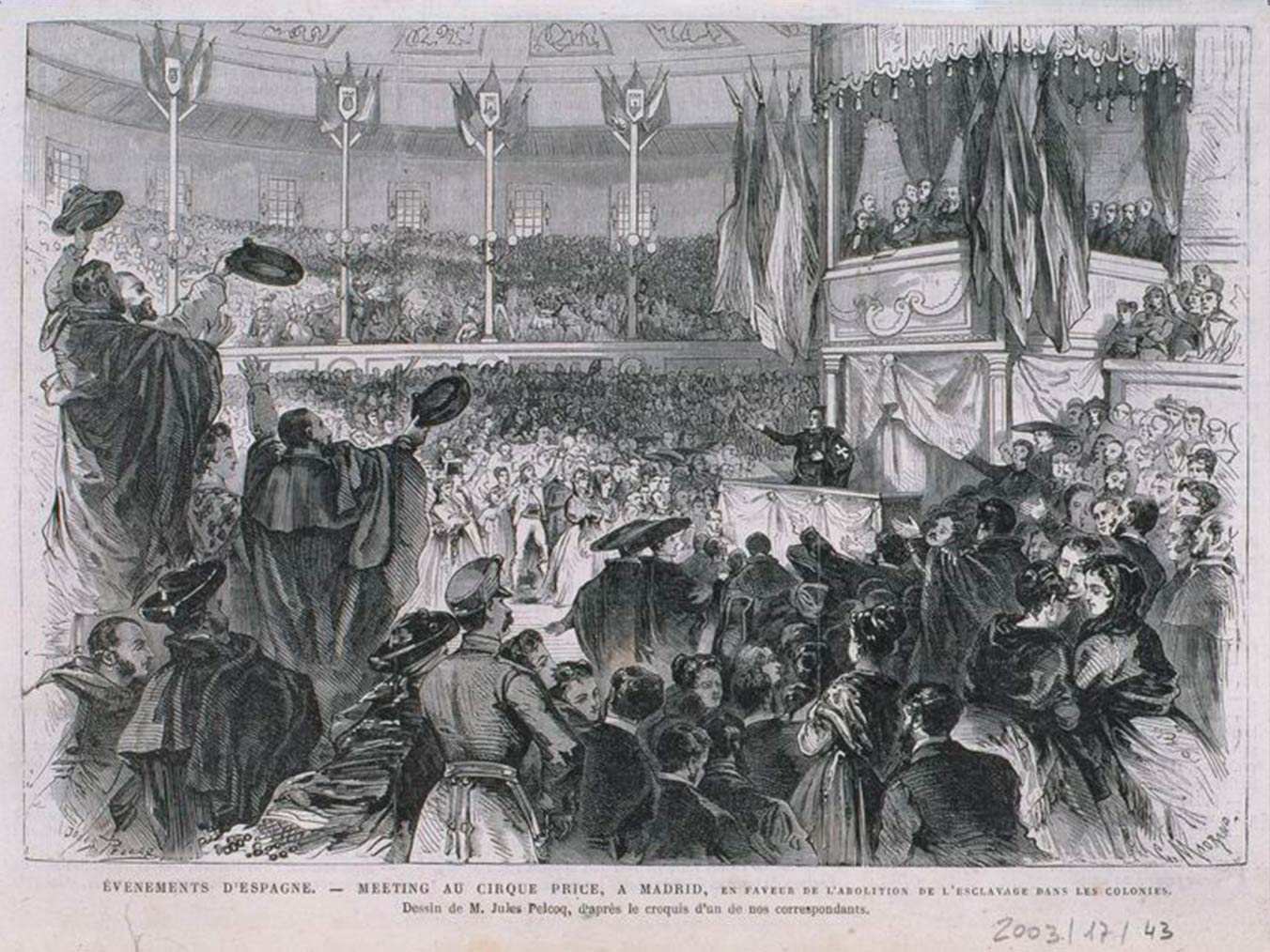
Évenements d’Espagne. Meeting au Cirque Price, à Madrid, en faveur de l’abolition de l’esclavage dans les colonies.
(Events in Spain. Meeting at the Price Circus in Madrid in favour of the abolition of slavery in the colonies)
Drawing by Jules Delcoq, 1873
Museo de Historia de Madrid
Demonstration in favour of the abolition of slavery in the Spanish colonies held in Madrid on 12 January 1873 and organised by the Spanish Abolitionist Society.
Museo de Historia de Madrid
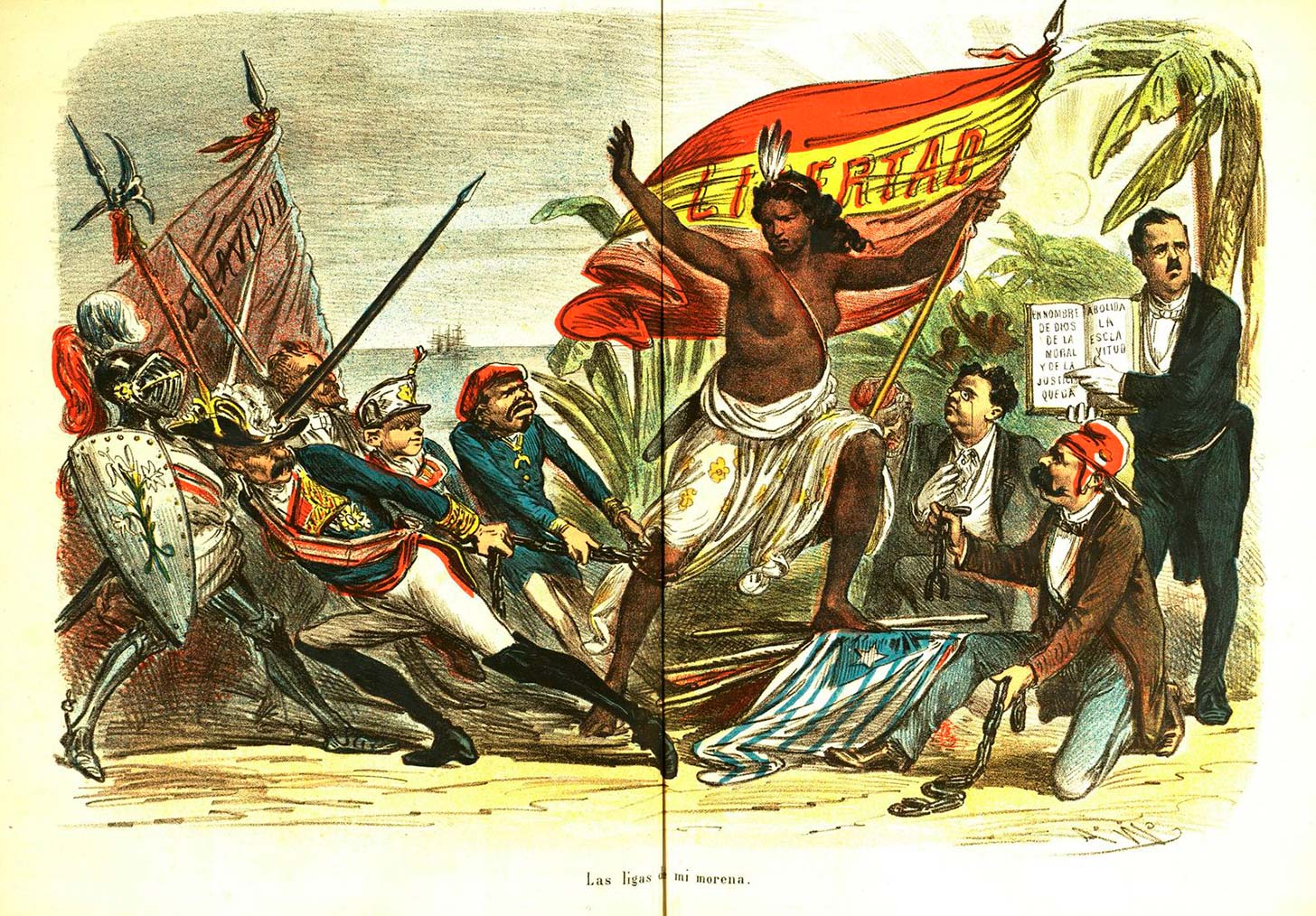
Las ligas de mi morena.
Cover of the satirical magazine La Flaca, no. 48 (year IV), p.2.
Vinyeta que mostra la divisió de la societat catalana davant l’abolició de l’esclavatge a Cuba. L’esclavatge cubà fa onejar la bandera espanyola amb la paraula “Llibertat”. Si a la dreta hi ha defensors de l’abolicionisme deslliurant-lo de les cadenes, a l’esquerra hi ha personatges que representen les oligarquies amb indumentària medieval militar o carlina, que les estrenyen més fort.
Illustration by T. Padrón, Barcelona, 1873.
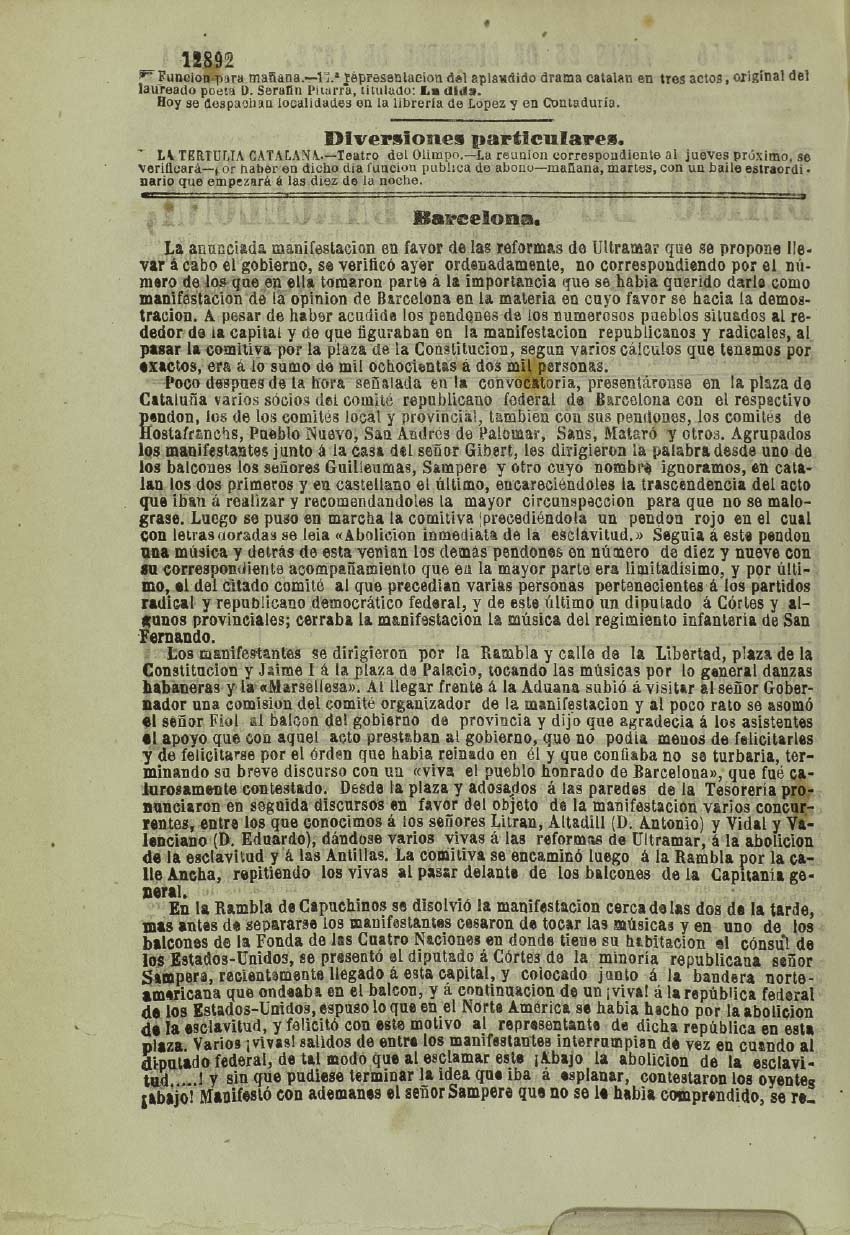
The 23 December 1872 edition of the Diario de Barcelona newspaper contains a detailed account of the demonstration held in the city the previous day to demand the abolition of slavery in the colonies.
You can consult the full text of the chronicle here.
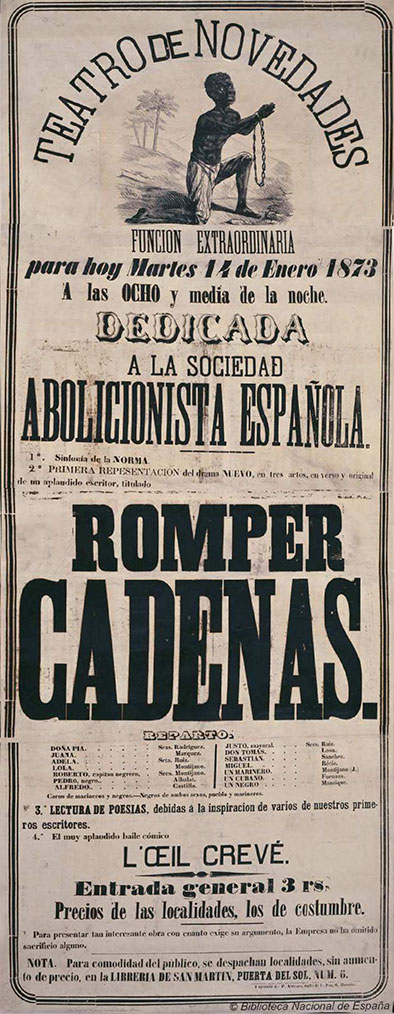
Poster for the play Romper cadenas (Breaking Chains) by Lluís Blanc, in support of the Spanish Abolitionist Society, premiered at the Teatro Novedades in Madrid in 1873.
Biblioteca Nacional de España.