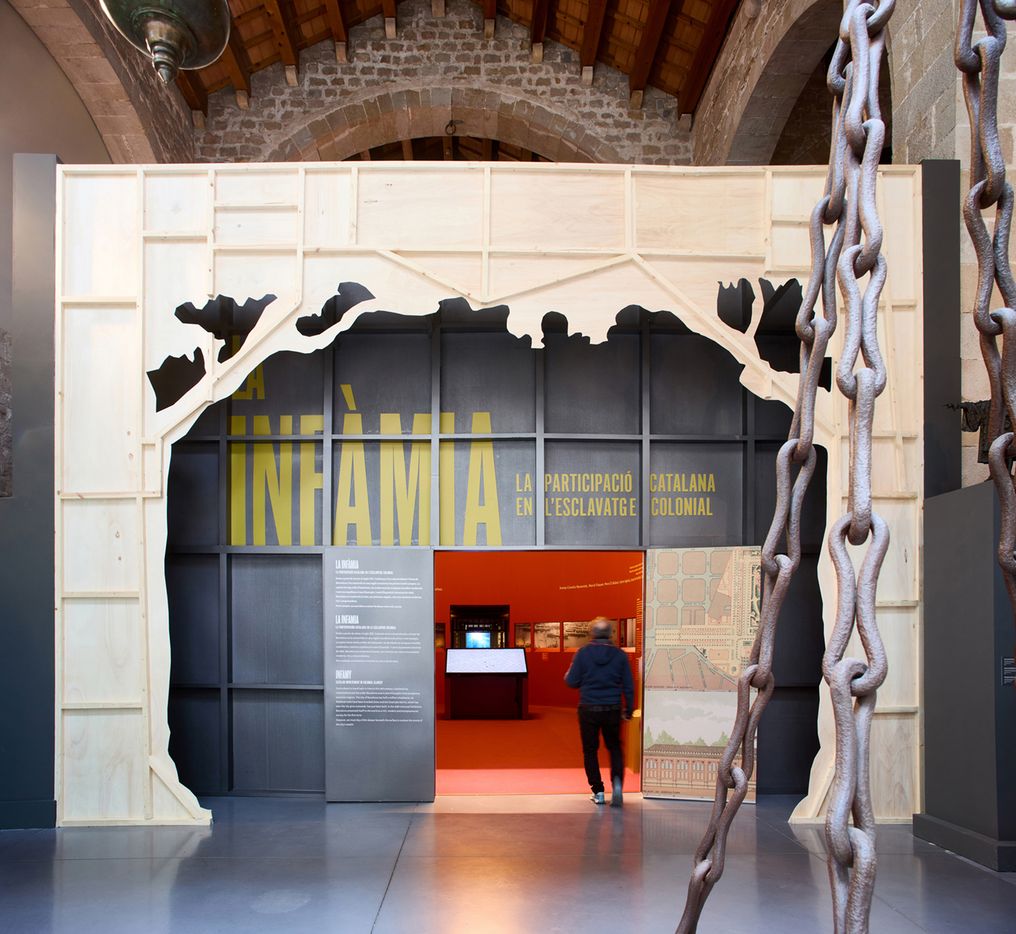
THE
INFAMY
CATALAN INVOLVEMENT
IN COLONIAL SLAVERY
The project The infamy. Catalan Involvement in Colonial Slavery, led by the Maritime Museum of Barcelona, was conceived to encourage reflection on the role of Catalan society in the trafficking of enslaved people and slavery during the colonial era, as well as the influence and lingering remnants of this phenomenon in contemporary society.

THE
INFAMY
CATALAN INVOLVEMENT
IN COLONIAL SLAVERY
The project The infamy. Catalan Involvement in Colonial Slavery, led by the Maritime Museum of Barcelona, was conceived to encourage reflection on the role of Catalan society in the trafficking of enslaved people and slavery during the colonial era, as well as the influence and lingering remnants of this phenomenon in contemporary society.
Several European countries have, for some years now, been re-examining their colonial past, their involvement in the trafficking of enslaved people, and the responsibility they bore in that brutal trade, which affected nearly twelve and a half million Africans between the 15th and 19th centuries.
And what about Catalonia? What was the extent of Catalan participation in the Atlantic trade of people taken captive to be enslaved? To what degree were Catalan merchants’ businesses – particularly in Cuba and Puerto Rico – built on enslaved labour? How did the profits generated by slavery contribute to the country’s development during the 19th century?
We do not know this history well. It has been scarcely researched, and only recently. These activities – some legal, others illegal- have left behind little documentation; and there is no family memory, neither among the merchants, the slave traders, nor the descendants of enslaved people.
The Maritime Museum of Barcelona is engaging in this process with the goal of prompting contemporary Catalan society – now more diverse and complex than in past times – to commit to re-examining its past. The project The infamy. Catalan Involvement in Colonial Slavery has been designed as a series of cultural and museological initiatives aimed at fostering reflection, from a present-day perspective, on the role of Catalan society in the trafficking of human beings and in slavery – especially during the colonial period – and on the influence and echoes of this phenomenon in contemporary society.